
Exhibiting care
Care-ful art on show

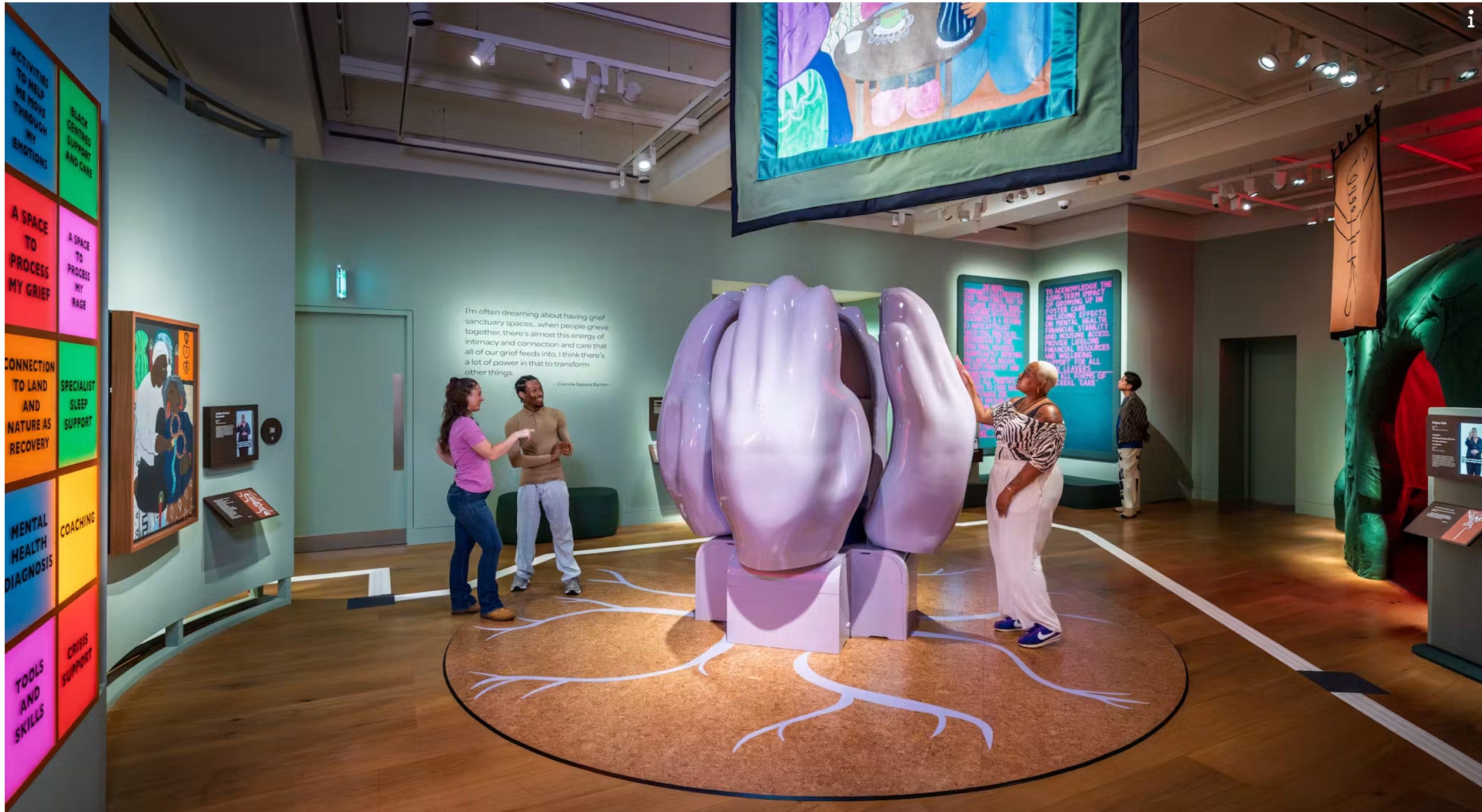
How do contemporary artists represent care in their work? And what insights can art offer into the experience of caring and being cared for?
These are questions I’ve explored in a number of episodes of the Careful Thinking podcast, including my conversations with philosopher and dancer Christine Leroy (Episode 7); with James Thompson, author of Care Aesthetics: For Artful Care and Careful Art (Episode 11); and with artist and care theorist Merel Visse (Episode 21); as well as in my Substack reviews of Christine’s book on Kinaesthetic Empathy, Ethics and Care, James’ co-edited volume on Care Aesthetics and the Arts, and Merel’s co-edited journal special issue on ‘Art for the sake of care’.
As a regular visitor to art galleries, I’ve also noticed that care has been the focus of a number of recent exhibitions, both here in Britain and abroad. Earlier this year the prestigious Albertina Museum in Vienna organised an exhibition with the title Care Matters, featuring works by contemporary women artists from the Verbund Collection. The exhibition was based on the premiss that ‘caring forms the foundation of human coexistence’ and it aimed to ‘make care work – often invisible and performed under precarious working conditions - visible’, seeking to increase ‘appreciation of care work, which is still predominantly performed by women.’
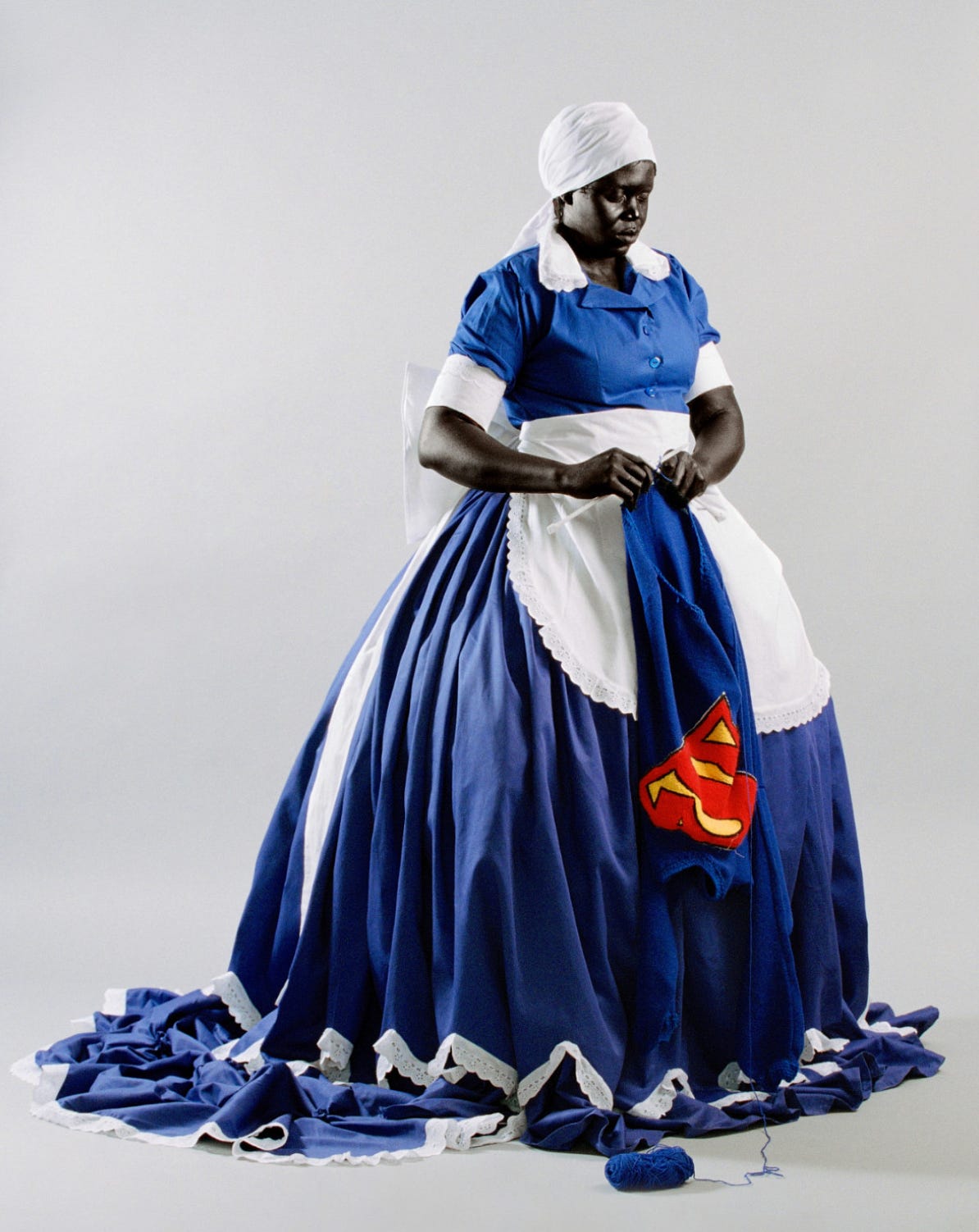
                            Mary Sibande, 'They don’t make them like they used to', 2008
                                        Verbund Collection, Vienna  © Mary Sibande
For those of us unable to visit the exhibition in person, the museum website usefully features a selection of images from the show, which give some sense of the kind of works exhibited. I was struck by one particular piece (above) by South African sculptor, painter, and installation artist Mary Sibande, whose work interrogates the intersections of race, gender and labour in her home country, exploring her own family’s legacy of forced domestic work under apartheid. As someone commented when Sibande posted this image on her Instagram site: ‘This spoke to me...it reminds me of all the sacrifices my mom and grandma made just so I could have a future.’
Judging by the selection of images on the Albertina website, the exhibition focused more on women’s domestic labour than on interpersonal care. However, some of the featured art works explored maternal care, a striking example being German conceptual artist Hannah Cooke’s photographic composition Ada vs Abramović (below), created as a response to Serbian performance artist Marina Abramović’s claim that it’s impossible to combine a life dedicated to art with motherhood. Cooke stages herself with her infant daughter Ada in a setting which ‘quotes’ Abramović’s work The artist is present, while in a parallel work she does something similar with British artist Tracy Emin’s creation My Bed. As art historian Nicole Grothe, writing on Cooke’s website, comments: ‘In these two works she shows herself to us as an artist and a mother and challenges us to question stereotypes’. Cooke has also exhibited her work here in England: for example, as part of the 2025 Motherother show at the New Bridge Project in Newcastle upon Tyne, which explored ‘the relationship that artist mothers have with themselves, their children, society, politics and the artworld.’
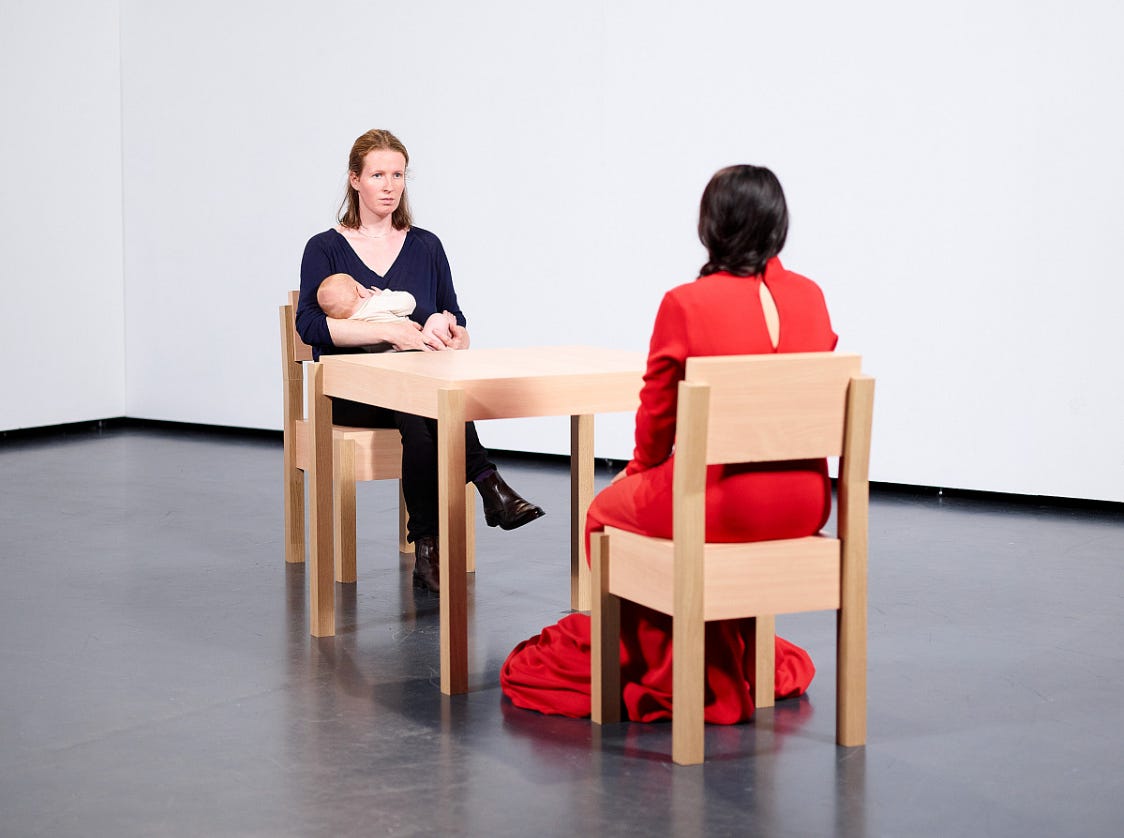
                                       Hannah Cooke, 'Ada vs. Abramović', 2018
                    Verbund Collection, Vienna © Hannah Cooke / Bildrecht Vienna 2026
Meanwhile, in Germany, the Goethe University in Frankfurt recently staged an exhibition with the title Who Cares? , which posed the questions ‘who’s taking care of you, and who or what are you taking care of?’ Visitors were invited ‘to explore the concept of care – encompassing caregiving, care work, and mutual responsibility – in new ways’. The exhibition showcased objects from the university’s own collections, ‘ranging from scrapbooks and “housewife” magazines to dried plants, complemented by artistic works created by students from the faculty of art education’.
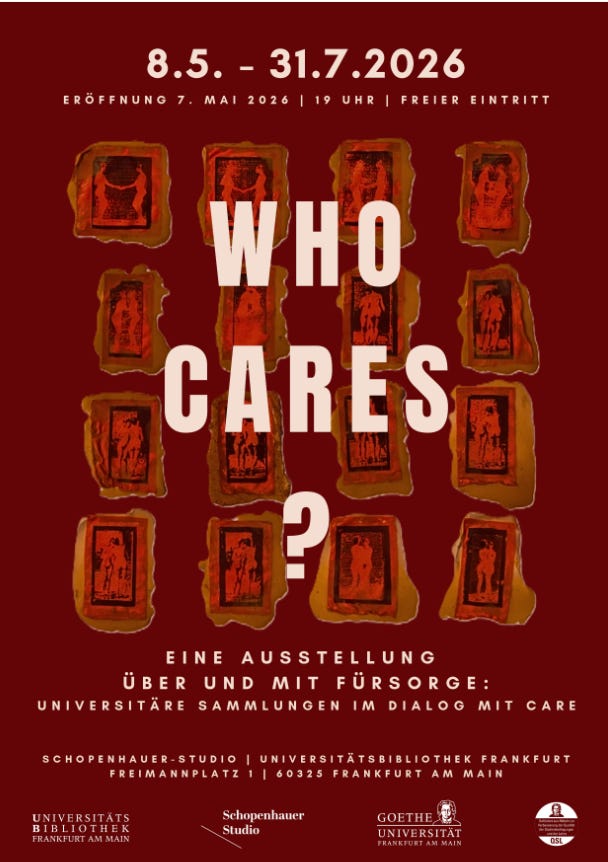
Image via uni-frankfurt.de
Given my interest in the language of care (see these posts), I was intrigued to see that both of these exhibitions in German-speaking countries use the English word ‘care’ in their titles. In fact, the Frankfurt exhibition uses both ‘care’ and its German equivalents in its publicity material: the poster reproduced above bears the slogan eine Ausstellung über und mit Fürsorge (‘an exhibition about and with care’), using a German word, but then underneath adds universitäre Sammlungen im Dialog mit Care (‘university collections in dialogue with care’), reverting to the English term.
Besides Fürsorge, the German language has a number of other words for care, including Sorge and Pflege, the latter being used mainly in the context of healthcare. And in the original German of that strapline for the Frankfurt exhibition – ‘who’s taking care of you, and who or what are you taking care of?’ - the verb kümmern is used: as I noted in this post, it has the same root as the word for sorrow or lament, just like the English word ‘care’. Interestingly, the sentence that follows on the exhibition website - Welche Geschichten erzählen Objekte aus universitären Sammlungen über Care und Fürsorge? - uses both the English and German words, as if confirming that they convey subtly different meanings: in fact, Google Translate here renders Fürsorge as ‘solicitude’ rather than ‘care’.
While I was searching online for information about the Who Cares? show, I came across publicity material for another recent exhibition in Frankfurt, which also chose to use the English word ‘care’ in its title. Yes, We Care: Das Neue Frankfurt und die Frage nach dem Gemeinwohl (‘The New Frankfurt and the Question of the Common Good’), at the Museum Angewandte Kunst, focused on the themes of ‘caring for the common good and the provision of essential public services, examining the institutions, associations, individuals, concepts, and initiatives involved during the 1920s.’ The exhibition ‘drew parallels to today’s “care crisis,” which manifests not only in debates regarding the unequal distribution of care work between men and women but also in issues of access to affordable housing and the availability of care services within urban neighbourhoods.’
Once again, it’s interesting that the original German text uses the terms Care-Krise and Care-Arbeit for ‘care crisis’ and ‘care work’ respectively. A later sentence goes on to explain why the English word ‘care’ might be preferable in this context. Here’s the German original:
Der Begriff „Care“ meint Pflege und Fürsorge, aber auch Betreuung, Sorgfalt und Obacht. „Care“ hat eine zwischenmenschliche und zugleich eine sozialpolitische Dimension. „Care“ schließt immer die anderen mit ein, ganz gleich, wer sie sind und wie viele.
And here’s an approximate English translation:
The term ‘care’ encompasses nursing [Pflege] and welfare [Fürsorge] but also supervision [Betreuung], attentiveness [Sorgfalst], and looking out for others [Obacht]. ‘Care’ has both an interpersonal and a socio-political dimension. It always involves other people - regardless of who they are or how many there are.
Although care ethics is not explicitly referenced here, the emphasis on attentiveness and on the socio-political dimension of care clearly owes a debt to the the work of care ethicists like Joan Tronto who have explored care as both a moral disposition and a political imperative. It’s precisely because the English word ‘care’ has acquired these distinctive connotations that scholars working in other languages have often made the deliberate decision to use it in preference to equivalents in their native tongues (see, for example, the ground-breaking book Qu’est-ce que le care? by French scholars Pascale Molinier, Sandra Laugier and Patricia Paperman, published 25 years ago this year).
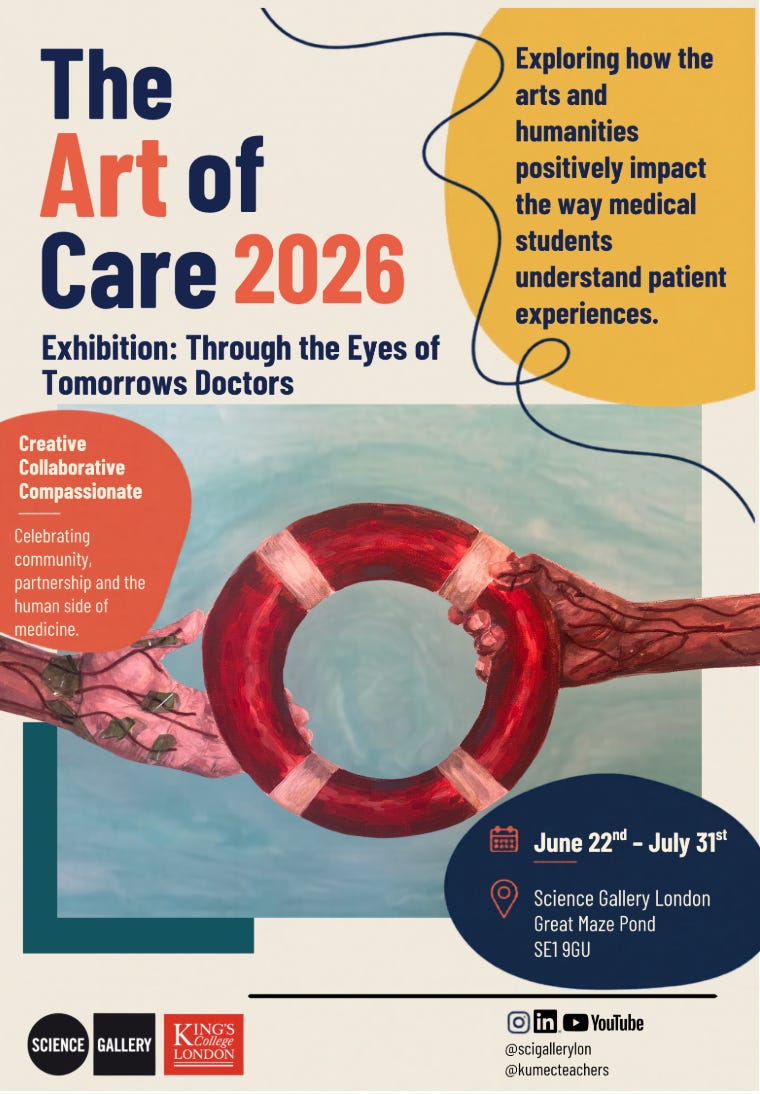
Image via london.sciencegallery.com
Closer to home, another exhibition exploring the art of care, which closed just a few days ago, was the regular annual show of creative work by medical students, at the Science Gallery in London. The Art of Care 2026 presented ‘creative reflections on care, community, and clinical learning’ by second-year medical students from King’s College London, produced during their year-long GP placements, which offered them ‘a unique insight into the everyday realities that shape health, illness, and access to care’. Supported by clinicians and artists, ‘students responded to their experiences through a wide range of creative media - including painting, sculpture, poetry, photography, film, and interactive work’. The exhibition explored themes such as ‘multiculturalism in healthcare, living with chronic illness, and digital and social barriers faced by vulnerable communities.’
The initiative provides encouraging evidence of the growing interest among health professionals in medical humanities, an interdisciplinary field which connects medicine with the arts, philosophy and social sciences, helping clinicians to understand and embrace the human and cultural aspects of illness. Although the exhibition has now ended, its website is still ‘live’ and features insights from some of the students who participated, together with illustrations of their creative work. For example, Ayesha Irfan Syeda writes that ‘this experience has taught me that being a future doctor means more than diagnosing or treating - it means listening with humility, recognising silence as a symptom, and creating a space where people feel safe enough to speak their truths.’ Another student, Max Powell, comments that by taking part in the project ‘I’ve come to understand that truly caring for a person means looking beyond their diagnosis - to their mind, their environment, and the communities that sustain them. This perspective has reshaped how I understand medicine, grounding it in empathy, understanding, and respect for the whole person.’
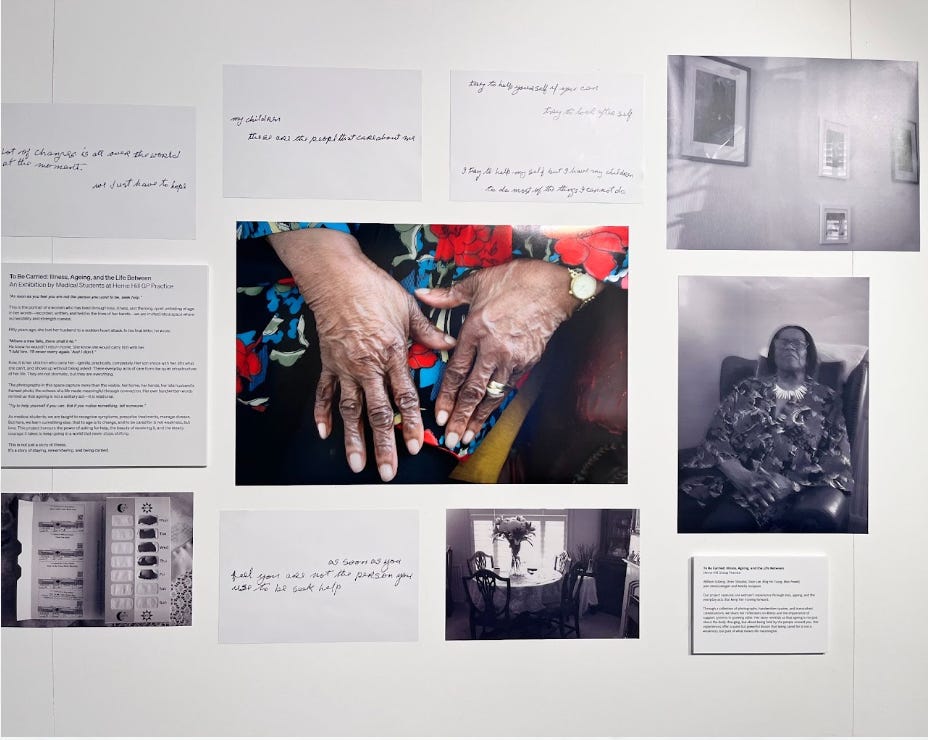
            Herne Hill Group Practice - ‘To Be Carried: Illness, Ageing, and the Life Between’
                                                       (Max Powell’s project)
Also in London, and continuing until February 2027, the Wellcome Collection - a free museum and library near Euston station - is showing an exhibition entitled Intimacies of Care - Spaces of Grief and Possibility, featuring the work of multidisciplinary artist Rudy Loewe, which ‘reimagines a mental healthcare system that is equitable and supportive’. The exhibition deploys ‘a network of sculptures, paintings, text-based work and sound’ to ‘centre the lived experience of Black people whose mental healthcare in the UK is shaped by racist discrimination.’ The works featured ‘ask us to consider more hopeful, empathetic, alternative approaches to care’.
Finally, I’m pleased to be able to publicise an exhibition that opened just a few days ago and looks like it will be well worth a visit. I’ve mentioned the Whitworth Art Gallery in Manchester here before: it’s home to the Care Lab, an organisation that explores ‘artful, creative care’, hosting regular seminars and workshops, as part of the Care Aesthetics Research Exploration (CARE) Project led by James Thompson.
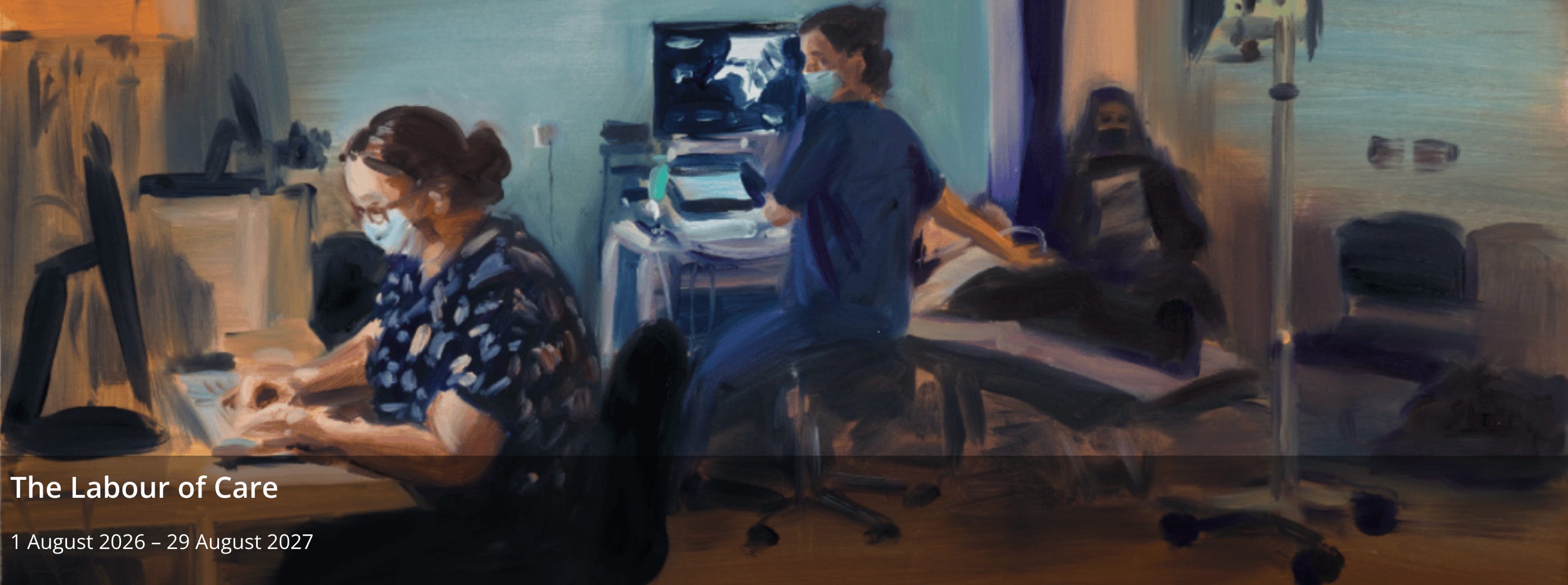
Image via whitworth.manchester.ac.uk
On 1st August the Whitworth, in partnership with Manchester University Hospitals NHS Foundation Trust, launched The Labour of Care, a year-long exhibition dedicated to ‘centring the voices and experiences of midwives and maternity healthcare professionals’. It features ‘artworks that explore care, labour and emotional resilience at the frontline of maternal health, providing insights into the realities of working in maternity services at a time of growing pressure on the profession’.
The exhibition developed from Still Care, a pioneering programme of artist-led workshops that began at the Whitworth in 2023 and which aims to ‘create space for maternity staff to pause, reflect and reconnect beyond the demands of the clinical environment’. It features new artworks created by healthcare professionals in their workshop sessions, side-by-side with selected works from the Whitworth’s own internationally renowned collection, placing participants’ lived experiences in dialogue with established artists such as Marina Abramović (mentioned above) and L.S. Lowry.
The painting used for the exhibition poster (above) is ‘Study for Ultrasound’ (2021) by Scottish artist Caroline Walker, a number of whose pictures, from her ‘Birth Reflections’ series, are featured in the show. Walker’s artistic work formed the focus of an exhibition earlier this year at Pallant House Gallery in Chichester, entitled Mothering, which explored ‘the beauty, strength, and unseen labour of childcare’.
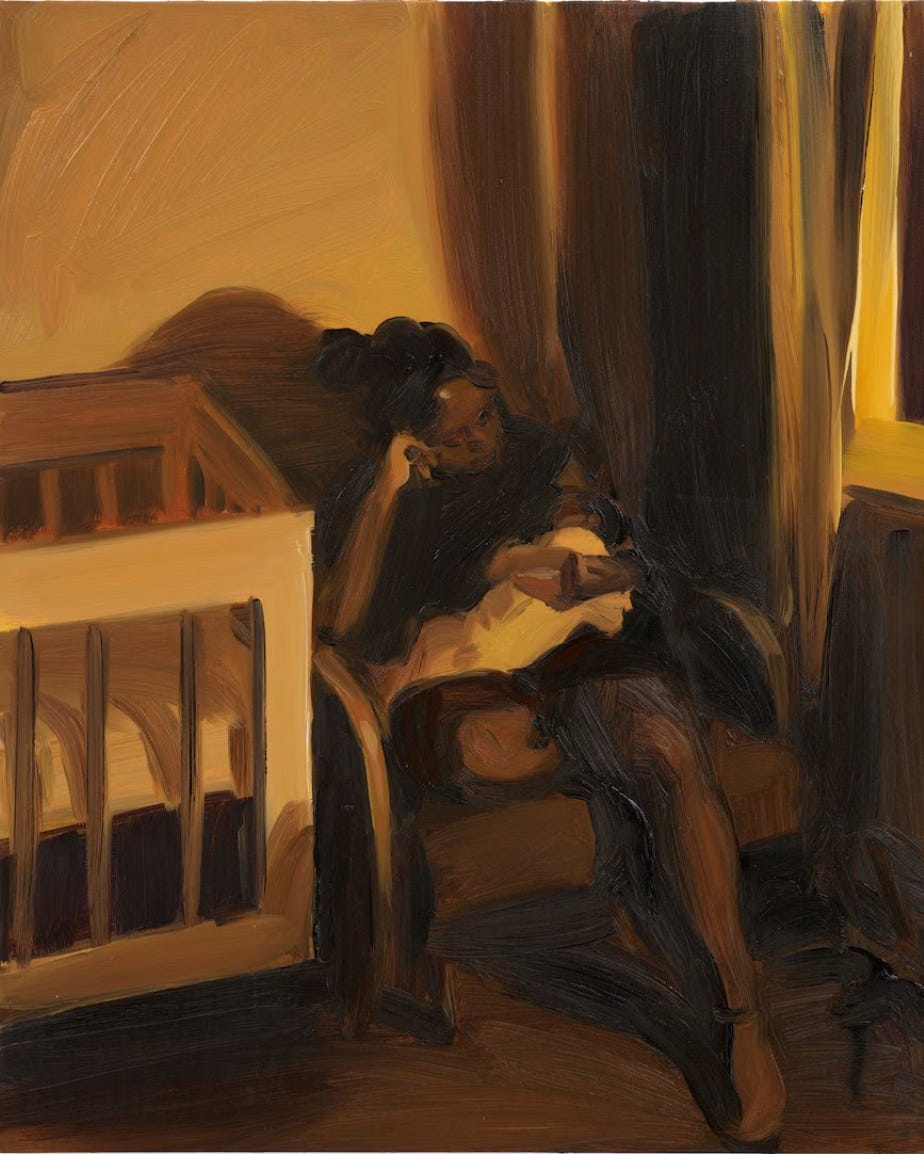
Caroline Walker, ‘Night Feed 1’, 2022
     © Caroline Walker GRIMM, Amsterdam/New York/London; Ingleby Gallery, Edinburgh;
                                     and Stephen Friedman Gallery, London and New York.
In their diverse and distinctive ways, all of the exhibitions that I’ve mentioned in this post offer evidence of a growing interest among artists and galleries in care as a vital and important subject for creative exploration. The work of the featured artists demonstrates the ways in which the visual arts can not only sensitively represent the experience of caregiving and being cared for, but also provide powerful vehicles for advancing and deepening our understanding of care as an embodied social practice.
If you’ve come across other exhibitions that focus on care, wherever they are in the world, please let me know, and I’ll promote them in future posts.
In other news…
Congratulations to legal scholar and care theorist Ira Chadha-Sridhar, currently a Junior Research Fellow at Cambridge University, on her appointment to a permanent post as Assistant Professor in Law at the University of Warwick. Ira, who was my guest in Episode 15 of the Careful Thinking podcast, and whom I had the pleasure of meeting in person in Cambridge at the end of last year, is one of the rising stars of contemporary care scholarship: I’m looking forward to her forthcoming book on Care and the Medical Mandate of Law.
And finally…
The Careful Thinking podcast is taking a break during August, but will return in early September with a new monthly series of conversations with writers, researchers and practitioners at the cutting edge of current thinking about care. Watch this space for updates.
…
The header image for this post is a photograph of the Intimacies of Care - Spaces of Grief and Possibility exhibition at the Wellcome Collection, London.
I think often about how care and domestic labor are connected but also different--and often conflated in feminist expression and what to do with that. I don't have an answer for this and am by no means telling anyone to stop making art about or talking about domestic labor, which is important to discuss and without a doubt connected to caregiver burnout. And yet I guess I would like to see more art about care that focused on dynamic and fluid relationships and not maintenance.
Martin, the Whitworth example sits differently from many of the others in your list. The work was made by midwives who were still inside the practice they were reflecting on. Elissa asked for relationships that move rather than maintenance. Here the relationship was still active after the object was finished. The makers went back to the work.