
Care and the state
Debating the role of government in care


What is the role of government in care? Should the state take greater responsibility for organising and providing care, or does experience show that the less politicians are involved in care the better? In short, can (and should) the state care?
These questions have been simmering away in the background of a number of recent episodes of the Careful Thinking podcast, so in this post I thought I’d pull together the diversity of views expressed by my podcast guests, in the hope of casting some light on the issue and stimulating discussion and debate.
In the most recent episode of the podcast, the legal scholar Erika Bachiochi expressed her admiration for the work of the feminist care theorist Eva Kittay, and especially her classic text Love’s Labor: Essays on Women, Equality and Dependency. However, Erika also criticised Kittay for seeming to regard the state as the ‘optimal’ provider of care and for resorting to state provision as ‘the first step’ in responding to a perceived deficit of care in families and communities. I must admit that I hadn’t noticed this tendency in Kittay’s writing as much as in the work of some other feminist care ethicists. For example, I recall reading Joan Tronto’s influential book Caring Democracy: Markets, Equality, and Justice when it was first published in 2013, and while I found myself in sympathy with Tronto’s emphasis on the centrality of care to human experience, I was wary of the book’s implied message that solving the current crisis in care was mainly the responsibility of governments, and that the state should play a more active and interventionist role in the provision of care.
In my conversation with her on the podcast, Erika Bachiochi offered an alternative analysis, drawing on the work of the legal scholar and diplomat Mary Ann Glendon:
One way [Glendon] puts it, I think is really helpful, is that in modern thinking we tend to have the individual, the market and the state, and those are the three actors. And we forget entirely about the family and the work of care in the family...but even some scholars who think about care a lot tend to want to talk about like, care infrastructure or care architecture. And they move directly from like the need for care straight up into the political and economic realm or the market and the state and really maybe give short shrift to the family.
There’s an echo here of Robert Putnam’s argument, in books like Bowling Alone: The Collapse and Revival of American Community, that in contemporary western societies the intermediate zone between the individual and the state – consisting of families, and civic and community associations – has increasingly been hollowed out. One result is that people tend to look more and more to the state – to the political realm – to solve their problems.
Mary Ann Glendon maintained that, rather than extending its own role in the provision of care, the state should introduce stronger measures to support families to care. As Erika said, ‘we really ought to be thinking a lot more about the family unit as a whole and the needs that the family has and the way in which the state can support that really important work of care.’ Of course, this is itself an acknowledgement that the state has a significant role to play in care, but as a facilitator and supporter rather than as the principal provider.

In talking with Erika, I was reminded of my conversation in an earlier episode of the podcast with political theorist and disability scholar Lorraine Krall McCrary. Lorraine explained how her own thinking had been influenced by Catholic social teaching, in which the principle of solidarity with the vulnerable is balanced by the principle of subsidiarity, according to which ‘government should support, assist and guide smaller associations rather than destroy and absorb them’, allowing individuals and associations freedom to act and ‘empowering a multiplicity of associations and approaches rather than standardising them’. Lorraine expressed a more positive view of feminist care ethics than Erika, suggesting that ‘the ethic of care approach often holds up as a model subsidiarity, or something like it, esteeming particular relationships of care and cautioning against care becoming bureaucratised, while seeing a need for government support of caregiving relationships, and for providing aid where those caregiving relationships do not exist, where people are left out.’ Lorraine identified ‘a recognition in care ethics that making care happen at the national level loses the interactions between individuals, the particularity, the listening that is really essential to care.’ At the same time, she recognised that the communities of care that she studied in her research depended on government funding and require government oversight: ‘And more than that...there are people who fall through the cracks in communities’, so that ‘there is a role for the state in care.’ She added: ‘I think the state is oversight, support, encouragement [and] the responsibility to help make a ground in which new communities can grow.’
Another disability researcher, Melody Escobar, who was my guest in Episode 22 of the podcast, and who like both Erika and Lorraine, has been influenced by Catholic social thought, came at the question from the opposite direction. On the basis of her research with parents of disabled children, Melody suggested that the experience of caregiving at the familial level ‘often does widen one’s sense of responsibility to others and to equity’ and can inspire an involvement in political action to support care. Lorraine described how the mothers in her study ‘weren’t just focused on the needs of their own children’ and how ‘over time, their caregiving led them to speak before legislatures and school boards and faith communities to advocate for access and meaningful change for all persons who experience discrimination’ - in other words, for state action to support care.
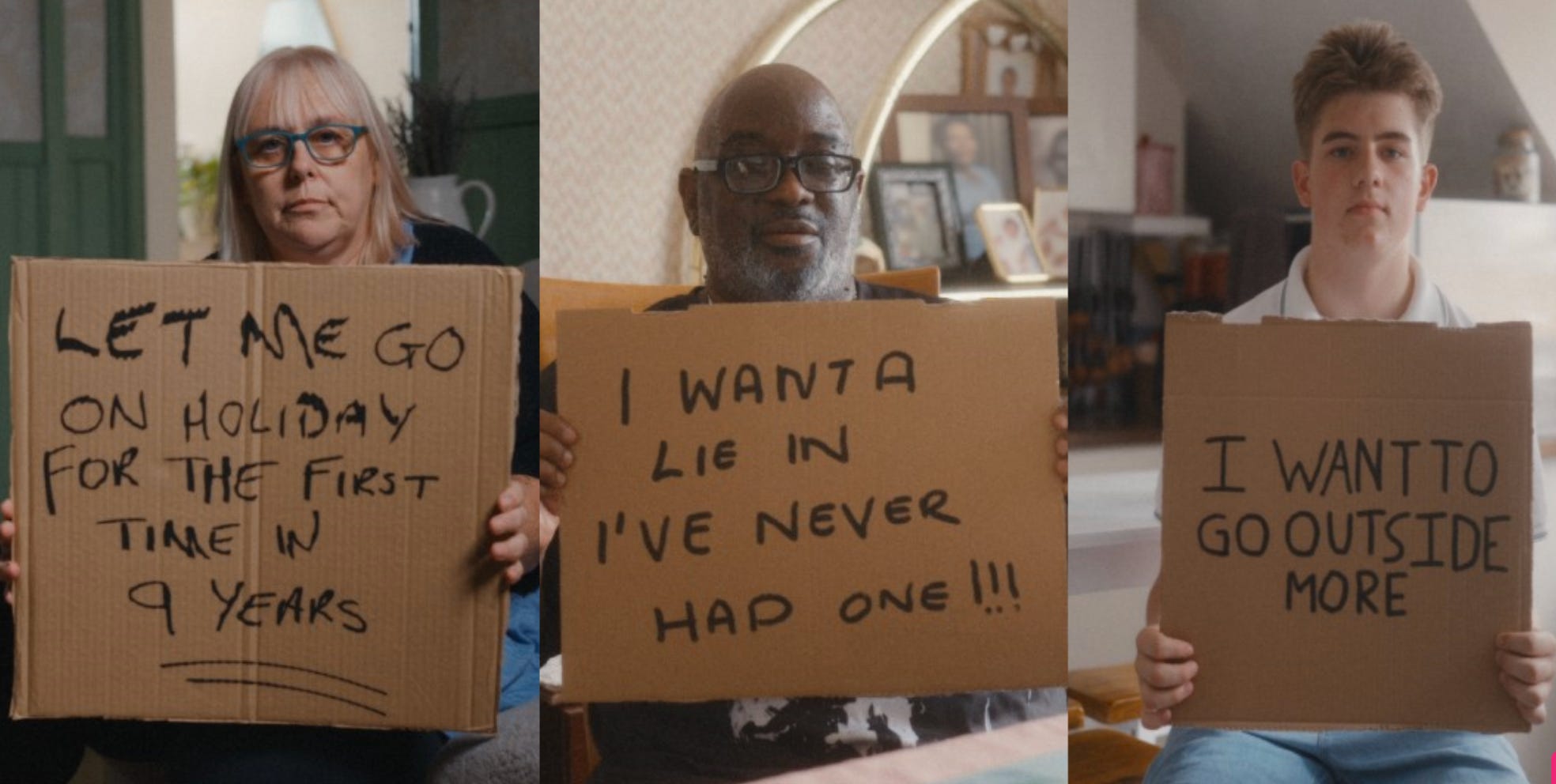
      Unpaid carers in the UK staging a virtual protest to demand a right to respite care
                                  ( Social Care Today, 21.07.25)
Melody went on to argue that ‘without practical supports and services [from government], even the most devoted caregiving becomes exhausting and unsustainable’, giving as an example ‘the need for accessible respite care, periods of rest which emerge strongly in the mothers’ stories, not only for the caregivers, but also for the children with disabilities who benefit from a break from the routine of daily life, experiencing new activities or forming connections with others outside the home’. She concluded: ‘So to truly support these families, I think care has to be seen not as the sole responsibility of individuals, but as something shared, backed by systems, services and communities that recognise the dignity and value of long-term caregiving.’
So, in different ways and with differing degrees of emphasis, all three of these Catholic writers share a sense that the state does have a significant role to play in care, though its primary function is to create and support the conditions for others to care, and only to become directly involved when care needs exceed the capacity of families and communities, or when, in Lorraine’s words, people ‘fall through the cracks’.
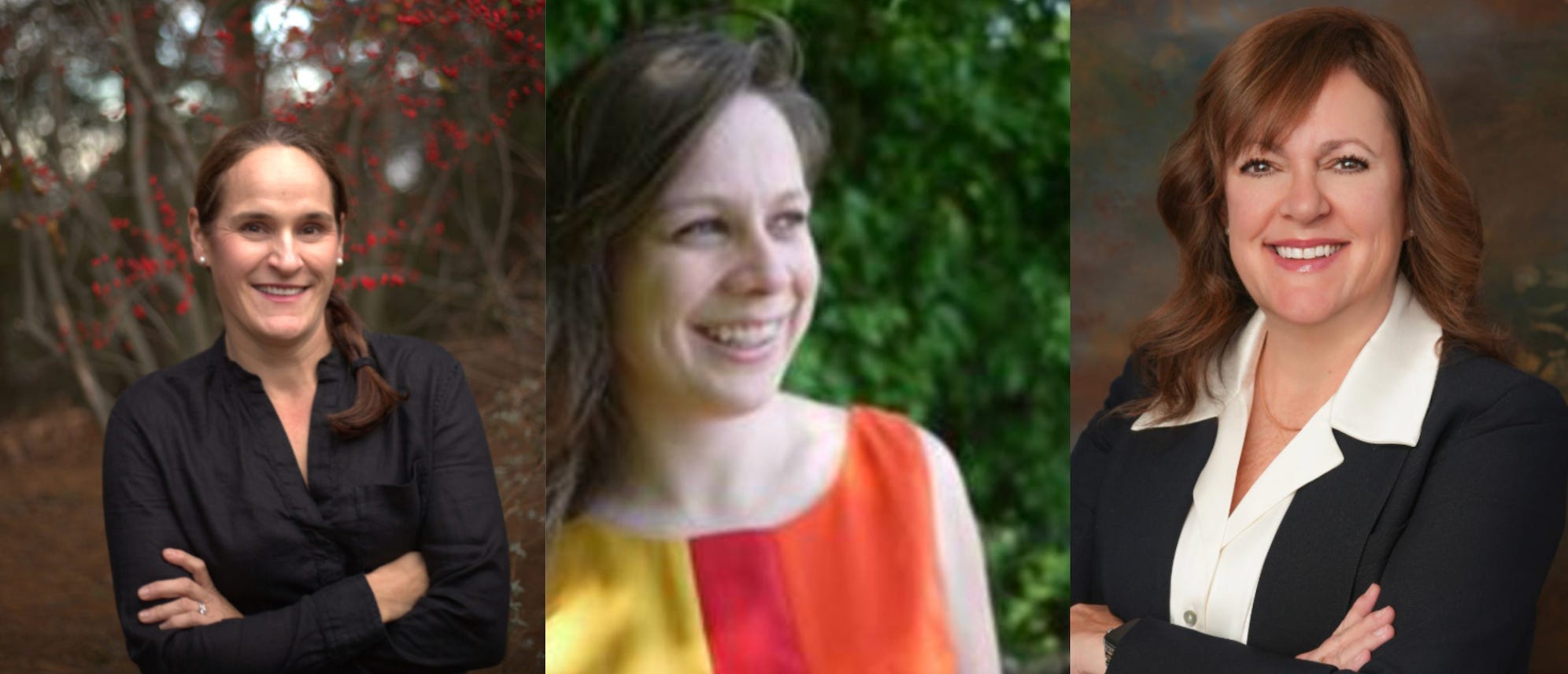
L to R: Erika Bachiochi, Lorraine Krall McCrary, Melody Escobar
However, other guests on Careful Thinking have argued for a more interventionist role for the state in care. Another legal scholar, Ira Chadha-Sridhar, argued in Episode 15 that ‘the state can use its powers to sometimes enforce moral responsibilities of care that we owe to co-citizens.’ Ira maintained that ‘when we have laws that encapsulate a genuine kind of moral responsibility to care, in those cases there is a moral duty to obey the law.’ She positioned herself against the libertarian tradition, according to which ‘the state...cannot use its coercive power to require that people act in order to meet each other’s needs’, maintaining instead that ‘the state can use its powers to sometimes enforce moral responsibilities of care that we owe to co-citizens.’
In one of the earliest episodes of the podcast, I challenged the social anthropologist Nigel Rapport’s assertion that the state, or at least its institutions, could be ‘caring’. In response, Nigel argued that what he called ‘cosmopolitan love’ has the potential to motivate ‘a kind of cosmopolitan politesse, a code of engagement that I would also claim that societies and governments and institutions might also take on’, and he maintained that ‘this kind of ethos might be turned into social policy and social practice’. Nigel held up the British National Health Service as an example of a ‘caring’ state institution, arguing that ‘care, as it’s practised by the NHS, is a kind of loving engagement of dealing with strangers...and this I take to be one example of how an institution might be caring’.
The philosopher and care theorist Maurice Hamington gives a chapter in his recent book Revolutionary Care: Commitment and Ethos what he admits is the rather provocative title ‘Socialism and the caring economy’. But rather than a government takeover of care, what Maurice is arguing for here is ‘an economy that makes a substantial investment in caring infrastructure to meet the needs of its citizens’ and supports a diversity of collective initiatives at different levels in society. As Maurice said when we discussed this question in Episode 6 of the podcast:
One thing about the care revolution that I envisioned [in the book] is that it’s all directions. And so it’s not just a bottom-up revolution and it’s not a top-down revolution. It’s an all-direction revolution. And so....I’m talking about socialism and the practices of infrastructure and so forth that a government can take. I also...discuss mutual aid and...more communitarian kinds of activities....And let’s do it all...we’re not going to rely on one caring saviour to put this all into place. We can push care at all levels, in all directions. And so on the one hand, for example, charity can be caring, but you still want to change the system so that less charity is even necessary. And both can be true.
To illustrate his point, Maurice recalled that he was ‘always impressed, growing up, with the Catholic Worker movement, because Dorothy Day and her organisation at one level would have soup kitchens and at another level would be protesting and trying to change policy at the same time, and they didn’t feel like their mission was just to do one kind of thing.’
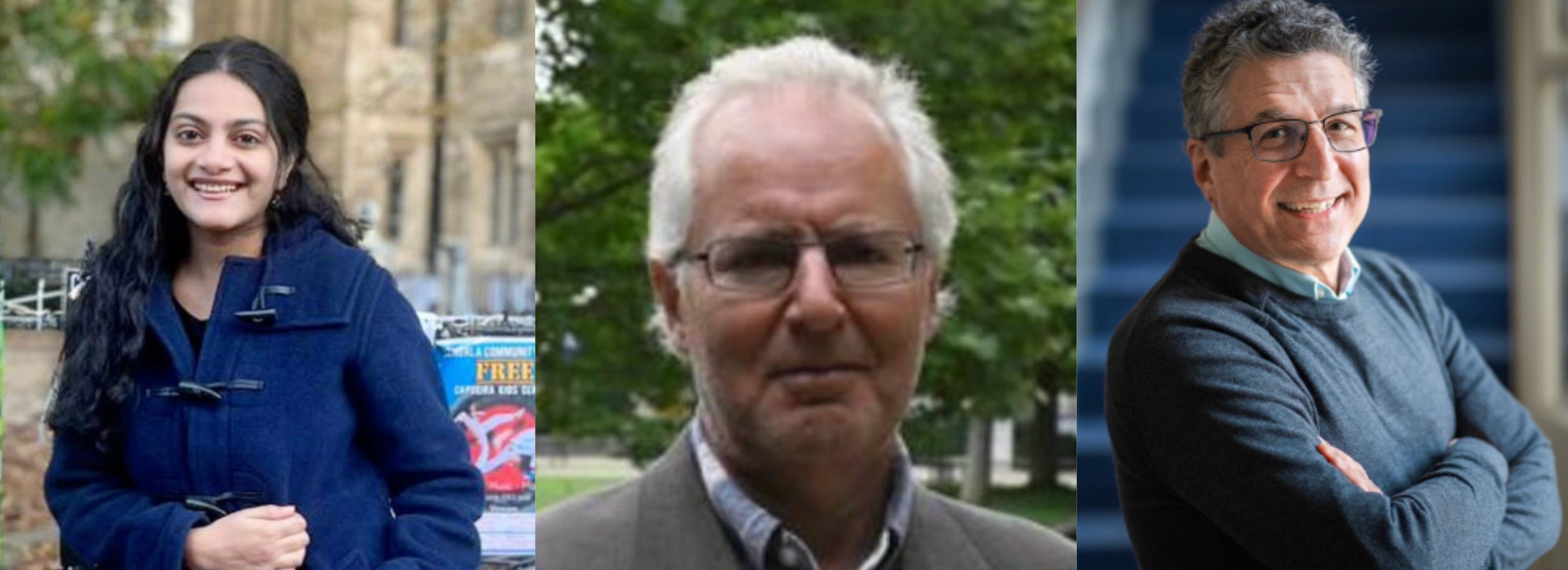
From L to R: Ira Chadha-Sridhar, Nigel Rapport, Maurice Hamington
That brings us full circle back to Catholic social teaching, of which Day and the Catholic Worker were an exemplary embodiment. Perhaps, as Maurice suggests, acknowledging that the state has a vital role to play in care doesn’t necessarily mean (as traditional socialists might maintain) that it has an exclusive role, but that it is one player (and a more or less significant player, depending on your viewpoint) in a mixed economy of care. At the same time, as Erika Bachiochi, Lorraine Krall McCrary and Melody Escobar all in their different ways argue, a belief that care happens best at the local level – in families and communities – doesn’t rule out maintaining that caregivers need the support of the state to enable and facilitate their caregiving.
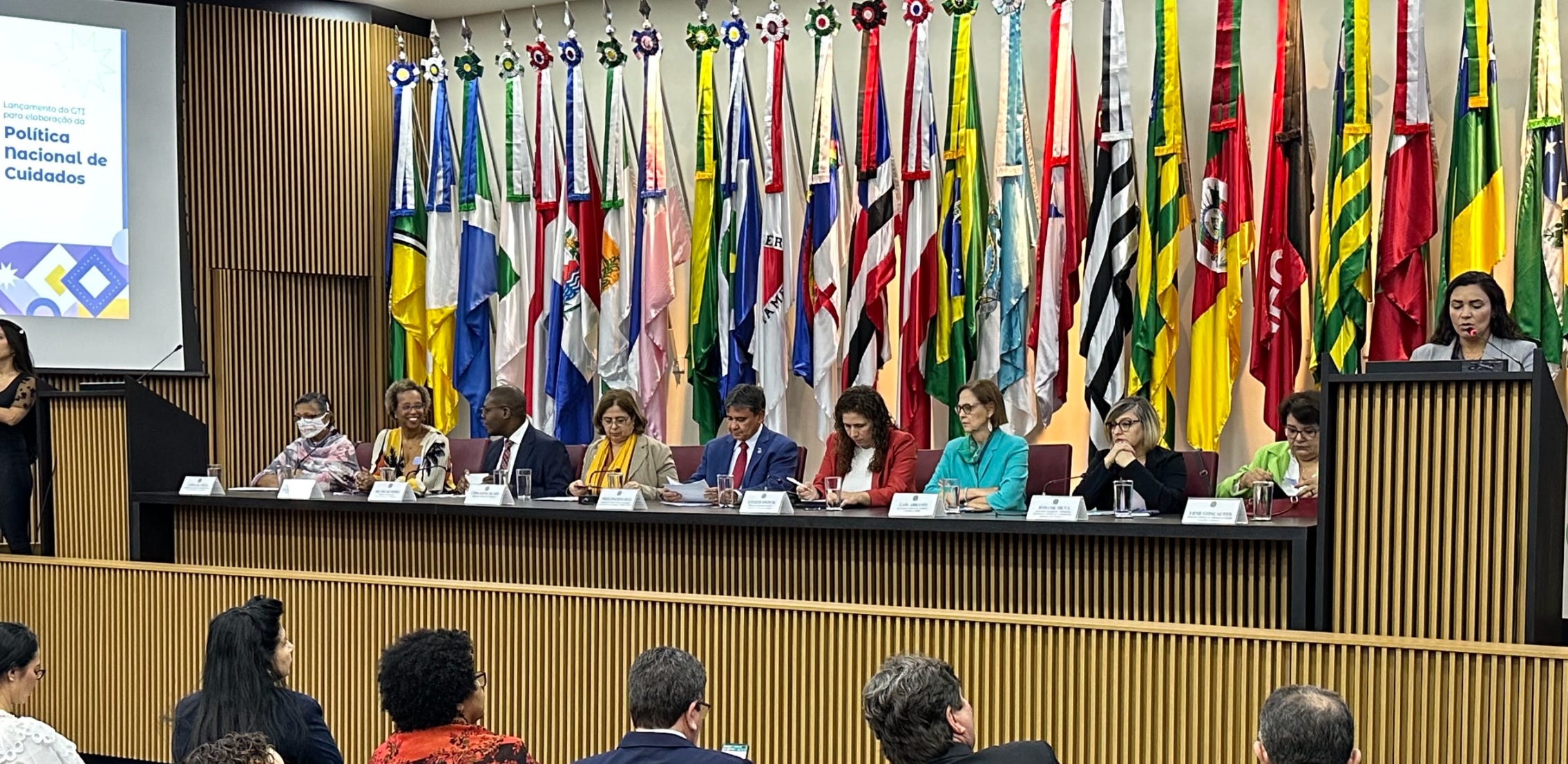
      Opening session of the launch of the interministerial working group set up to develop
                  Brazil’s National Care Policy (via https://agenciabelem.com.br)
These are very much ‘live’ issues at the moment, including here on Substack. I’ve been very interested to read Mélina Magdelénat’s recent reporting at The Fifth Wave Institute, on how national and local governments in Latin American countries have put in place structures to support care, partnering with community organisations rather than seeking to replace them. It reminded me of what the philosopher and care theorist Irene Comins Mingol told me, when I interviewed her last year, about the concept of cuidadanía (a neologism that blends the Spanish words for care and citizenship) developed by Spanish and Latin American scholars, ‘a form of citizenship grounded in empathy, relational responsibility, and an ethical commitment to others beyond one’s immediate social circles’. And in a forthcoming book chapter, the Catalan researcher Iris Parra Jounou describes how public policies based on care have been implemented by city authorities in Barcelona and Madrid: I’m looking forward to discussing these initiatives with Iris in a forthcoming episode of the podcast (watch this space). What these ideas and initiatives have in common is an attempt to find a new role for the state in care, and to develop a new understanding of the relationship between the state and those who care.
To conclude with the questions with which I began: if we concede that the state does have a significant part to play in care, what exactly is that role? And if we agree that governments’ main role with regard to care is an enabling one - that is, creating the conditions for families and communities to care - then how can they best do it? I’d be interested to hear what you think, so feel free to leave a comment below.
…
The header image is the painting ‘Who Cares’ by Los Angeles-based artist Sonia Mirzaei (permission requested).
This is a really helpful breakdown of all the different perspectives on this topic, Martin. (And thank you for including my article!) I especially like Maurice Hamington's idea that we can "push care at all levels, in all directions". Different levels of action don't have to be incompatible! And different actors can have both overlapping roles and their unique contributions: a state won't ever be able to love someone the way a family can, but there are some basic services that could never be properly provided to everyone by another institution than the state.
I must admit, it's hard to read the theory and aspirations when I've encountered so many harsh realities in the UK, Martin.
I haven't read your book, but from what you've shared here, your perspective and that of Melody Escobar are what many in the UK are already endeavouring to do, right now, to compensate for the delay in Government social care reforms and underfunding of the NHS.
For example:
- Unpaid carers are leaving work or, at a minimum, reducing hours to care for loved ones, and some people wonder why over-50s are 'retiring early' or not returning to work.
- In some areas in the UK, whether you are seeking paid carer support privately or by the social services, the agencies could be the same. There is limited availability of resources outside London its a 'postcode lottery'
- Charity is already playing a huge role in palliative/hospice and end-of-life care. NHS funding accounts for less than a third of operational funding.
- hospice home care is so limited (e.g. nurse care overnight) that families can only hope they'll be called that day to be told someone could come that night— not 'on-demand'. Charities are doing amazing work to prioritise those most in need.
I appreciate the different perspectives and opinions as you've laid them out.
The increased need for care has already outpaced changes in government policies and infrastructure; local projects are working hard to fill the gap.