
Protest, performance, and care - with Alisha Ibkar
Episode 25 of Careful Thinking

Episode 25 of the Careful Thinking podcast features my conversation with Alisha Ibkar. Originally from Kaliachek in West Bengal, India, Alisha has a Bachelor’s Degree in English Literature from Aligarh Muslim University in Uttar Pradesh and a Master of Arts degree, also in English Literature, from Jawaharlal Nehru University in New Delhi. She was a Commonwealth Scholar at the University of Warwick, where she completed a Master’s degree in Applied Theatre, with her dissertation focusing on the study of ethics and the aesthetics of care in the context of political activism.
Alisha is currently a School of Arts, Languages and Cultures Doctoral Fellow in Theatre and Performance at the Martin Harris Centre for Music and Drama in the University of Manchester. Since 2016, she has also held the post of Assistant Professor of English Literature and Language at Aligarh Muslim University. In Manchester, Alisha is associated with The Care Lab, which is partnered with the Care Aesthetics Research Exploration Project led by Professor James Thompson, who was my guest in Episode 11 of the podcast.

Alisha Ibkar (photo via The Care Lab)
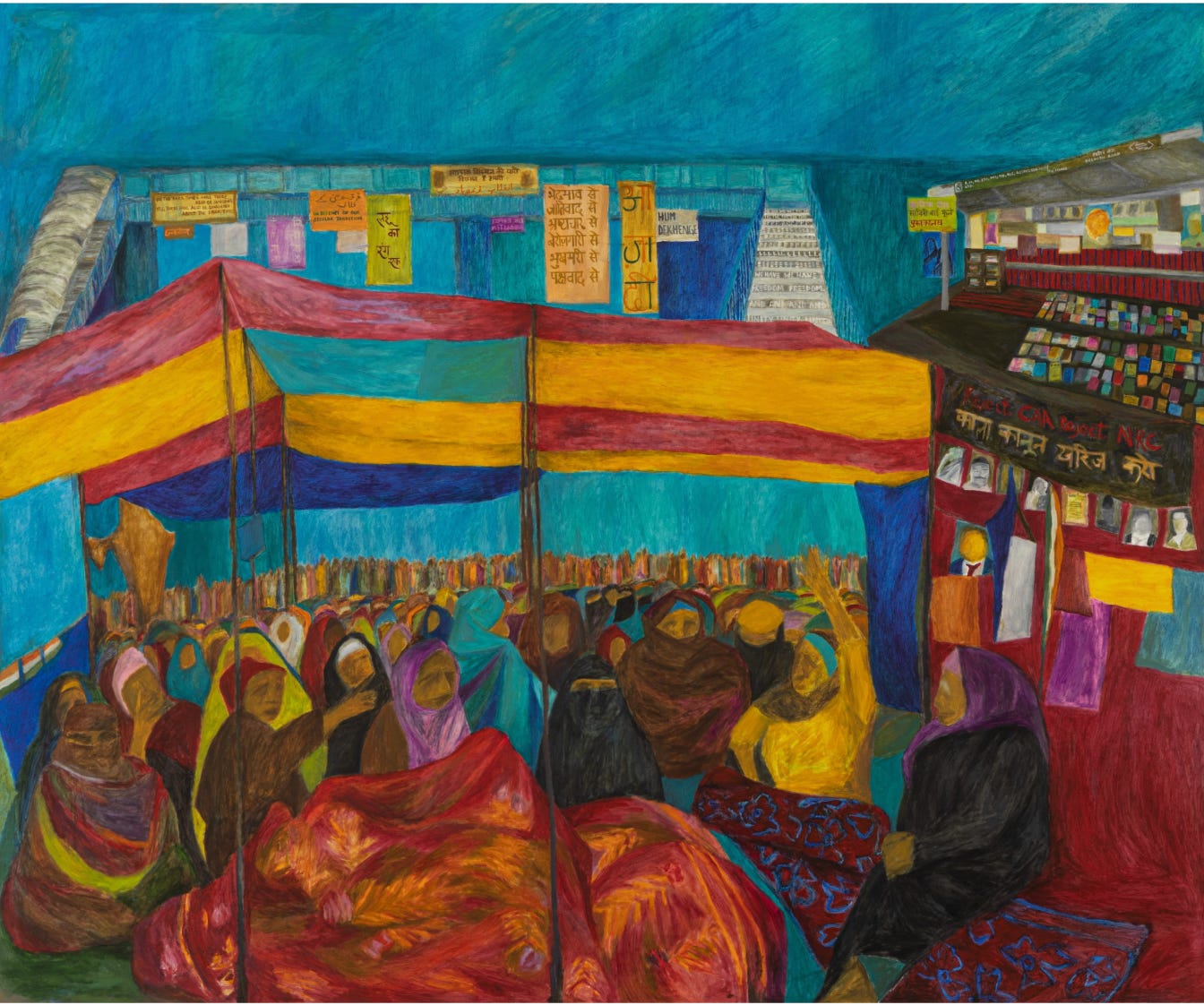
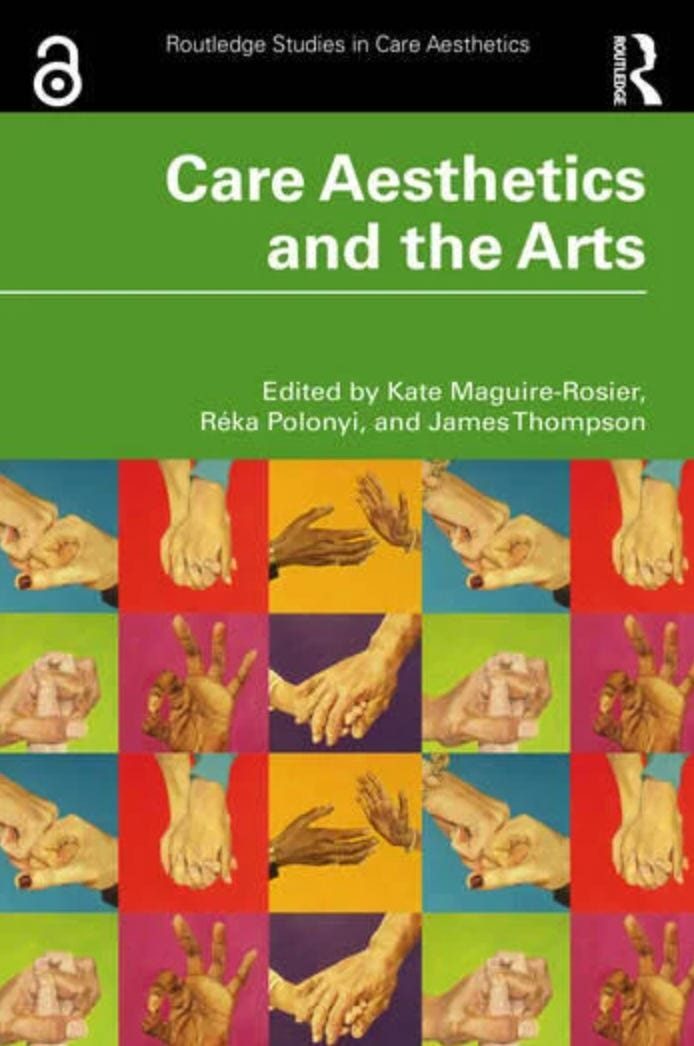
Alisha’s research sits at the intersection of care ethics, aesthetics, and emerging discourses on radical performance. Focusing on women-led social movements in India, and specifically on the protest by Muslim grandmothers at Shaheen Bagh, Delhi, in 2019-20, her work explores the significance of care in protest performances, both as a representative human practice and as a form of political expression. Alisha has published the findings from her research in The Sociological Review and Theatre Journal and has contributed a chapter on Muslim women’s everyday practices of care to a forthcoming edited collection on Care Aesthetics and the Arts.
The political dimension of care has been an important component of feminist care ethics from its inception, with political theorist Joan Tronto obviously an influential figure via her books Moral Boundaries: A Political Argument for an Ethic of Care and Caring Democracy: Markets, Equality, and Justice. Other important voices in advancing a political theory of care have included Daniel Engster, author of The Heart of Justice: Care Ethics and Political Theory, and co-editor with Maurice Hamington of the collection Care Ethics and Political Theory. Maurice, who was my guest in Episode 6 of the Careful Thinking podcast, also argues for viewing care as personal, political and revolutionary in his latest book, Revolutionary Care: Commitment and Ethos. All of these writers have made the case that a commitment to care requires a commitment to political action in support of care. However, Alisha Ibkar’s work is innovative in highlighting the caring dimensions of political action itself, though there are also some similarities with the arguments put forward by political scientist Lorraine Krall McCrary, who was my guest in Episode 23 of the podcast, and whose forthcoming book Care Communities: Politics in a Different Voice explores somewhat similar themes.
Alisha’s work also contributes something new to the burgeoning field of care aesthetics. As this year’s Care Ethics Research Consortium conference in Utrecht demonstrated, the aesthetics of care is one of the most exciting new areas of care theory. It’s one I’ve explored in a number of earlier episodes of the podcast, not only in my conversation with James Thompson, author of the ground-breaking Care Aesthetics: For Artful Care and Careful Art, but also in my interview with dancer and philosopher Christine Leroy in Episode 7 and my discussion with artist and care theorist Merel Visse in Episode 21. I also wrote in this post about the launch of the journal special issue on ‘Art for the Sake of Care’, co-edited by Merel and Elena Cologni. Alisha’s research takes the aesthetics of care in new directions, extending our understanding of the performative character of care, and at the same time encouraging us to see everyday caring activities, such as those carried out by the grandmothers of Shaheen Bagh, as a form of artistry.
At the same time, Alisha’s work is further evidence of the emergence of India as an important hub for the development of care theory, which was also apparent from my conversations with Ira Chadha-Sridhar in Episode 15 of the podcast and Priya Sharma in Episode 18, as well as my interview with Pragya Dev in this post. These developments can be seen as contributing to the broader de-colonial movement in care ethics, which I also explored with Nuevo Mexicana/Mestiza educator Mia Sosa-Provencio in Episode 19 and the Canadian Muslim feminist scholar Sarah Munawar in Episode 13. Perhaps not surprisingly, there were a number of commonalities between my conversation with Alisha and my interview with Sarah, not least in the fact that both of them highlighted the importance of storytelling, even mentioning some of the same Quranic narratives, in the care practices of Muslim communities.
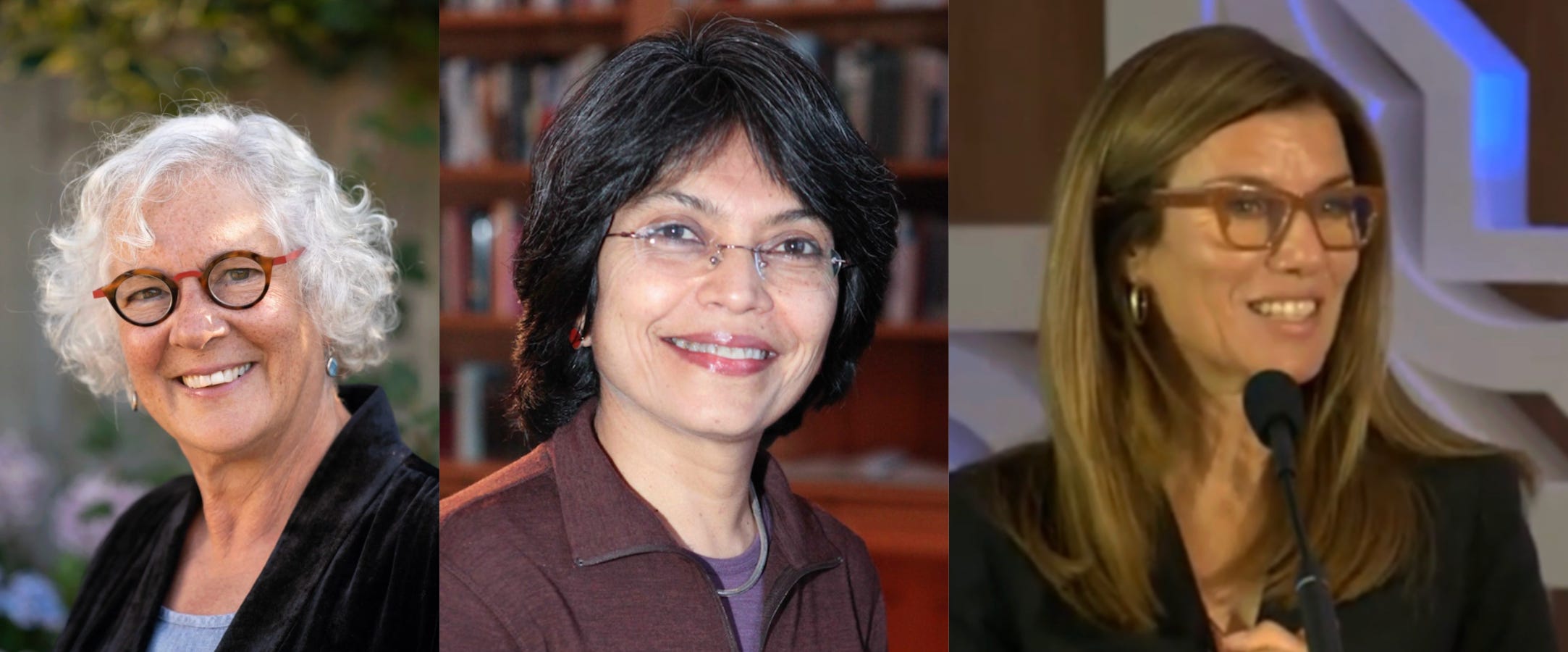
     Three of the Muslim feminist scholars cited by Alisha in the episode. From L to R: Lila
     Abu-Lughod, Saba Mahmood, Sherine Hafez
Our conversation in this episode of the podcast began by exploring the roots of Alisha’s ideas about care in her experience of growing up in a close-knit Muslim community in West Bengal, and the origins of her interest in performance in the community-based folk theatre of her childhood. From this we moved on to the influence of feminism on Alisha’s thinking, including her critique of some aspect of Euro-American feminist care ethics and appreciation of feminist thinkers from the Global South, including Islamic feminist scholars such as Lila Abu-Lughod, Saba Mahmood and Sherine Hafez. Alisha then explained the background to the campaign against the Indian government’s 2019 Citizenship Amendment Act, before describing how the protest by Muslim grandmothers at Shaheen Bagh came about, and why she decided to select it as a focus for her research. Alisha explained how she came to see care as a fundamental component of the protest, describing the structures of care that the women and their supporters put in place.
We then discussed how seeing these actions through the lens of performance might aid an understanding of how care circulates and is reproduced. Alisha argued that the everyday practices of care and hospitality by the women of Shaheen Bagh were profoundly ‘artful’ and a form of aesthetic practice. These activities included storytelling, which could be seen as a practice of both care and resistance. Our discussion then turned to the ways in which the women’s everyday care for each other nurtured a ‘caring imagination’ and a concern for the wider community, as well as modelling a politics of care that had broader political implications. In the final part of our conversation, Alisha talked about her involvement in The Care Lab in Manchester and about her plans for pursuing further research in this field.
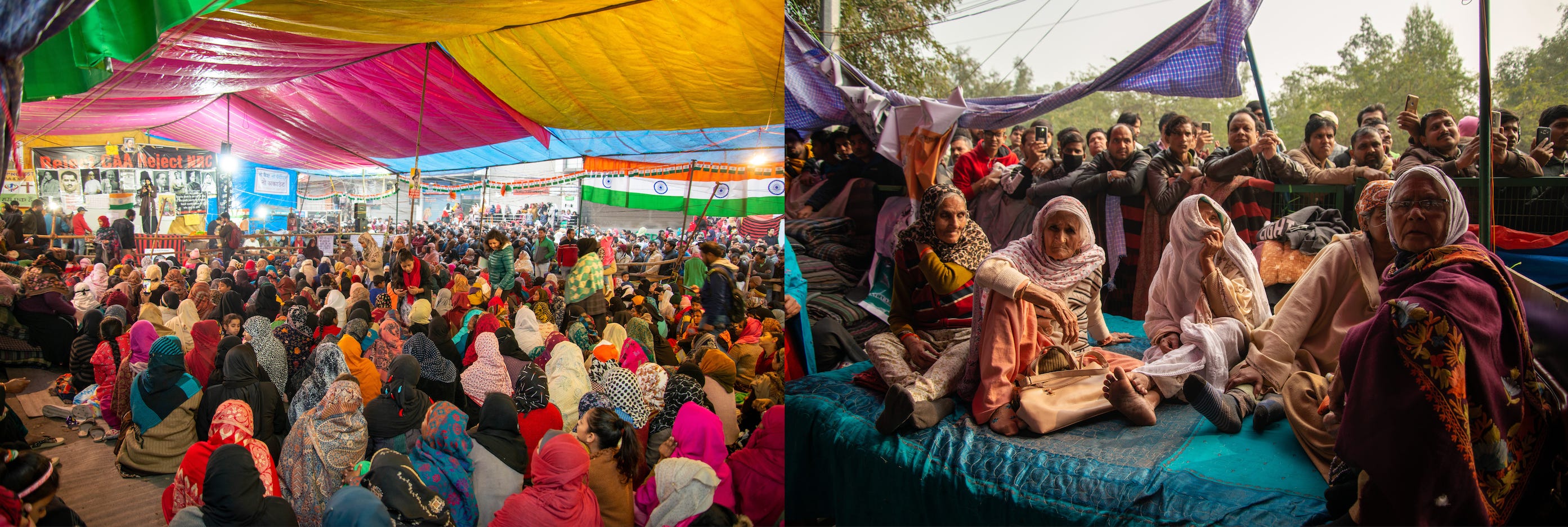
Images of Shaheen Bagh (via Shutterstock )
Here are some quotes by Alisha from our conversation:
We grew up hearing sayings and verses that shaped how we understand our responsibilities to others. Now, one hadith, or a religious saying that is often repeated in our homes and that has stayed with me was...‘The believers in their mutual kindness and compassion are like one body. When one limb suffers, the whole body responds with wakefulness and fever’. And that image of the entire body responding to the pain of a single limb has deeply shaped how I think about community and care as an ethical orientation....Showing up for someone who was unwell, carrying a basket of vegetables to a neighbour’s house, and somehow returning with two cans of milk, all of this felt ordinary. But now, looking back from where I am, I see how much of those early experiences shaped my understanding of what it is to belong and to be a part of a community. And later, as I began to think about care more academically, I started to recognise these small, everyday acts as part of a larger ethical and political formation.
...
I draw a lot from the big names in feminist care ethics...Their work has been foundational for me. It helped me really understand care as a political as well as an ethical practice. But I have also recently become more critical of how a lot of care theory is being read and discussed from Euro-American positions. It has Euro-American assumptions of what care looks like, who performs it, and under what conditions. So my effort now is to think from elsewhere, to extend and complicate care theory by grounding it in lived experiences from the margins, where the ability to give or receive care is shaped by one’s class, one’s caste, one’s religion, gender, location, among other things.
...
I think that one moment has become the lens through which I now understand Shaheen Bagh. It opened my eyes to a whole world of these seemingly routine, ordinary gestures that I might have just otherwise overlooked because our attention is so instinctively drawn to the grand and spectacular: the crowds, the flags, the chants, the hundred thousand people standing together and singing the national anthem….But what I realised at Shaheen Bagh was that beneath those revolutionary moments lay another register of collective life. The exhausting, exhausting labour of taking care of one another, the quiet work of maintenance, the allaying of fear, the invisible groundwork that makes protests possible. You see, many of the protesters I spoke with during my fieldwork in India earlier this year recalled how after long days of work, when they would arrive at Shaheen Bagh, the dadis would immediately ask, ‘Have you eaten? Are you warm? Are you tired? Do you need to rest for a while here? Why don’t you sleep and take a nap here?’ And before anyone could answer, they would open their tiffin boxes and offer whatever food they had brought from home. And this was what the dadis would call a practice of khatirdari in Urdu, their practice of hospitality that they brought to the site that made everyone feel so welcome, so at home. Over time, these repeated gestures of care became the very texture of life at Shaheen Bagh.
....
Looking at the dadis’ actions through the lens of performance allows me to better understand care as a practice, to see it as something that’s enacted, embodied, and shared in public. The concept of performance helps me think more critically about how care circulates. How is it shared? How is it received? How is it witnessed? And what happens once it is witnessed? And how is it then reproduced or transformed through repetition? It allows me to understand what happens to care when it moves into a public space. What happens to its meaning when it becomes visible? What happens to its meaning when it is collectively performed? How does it travel? How does it change? And in this sense, performance for me, becomes a way also of tracing the afterlives of care. How does it linger? How does it stay within us? How does it travel? How does it slowly become a part of the moral and political fabric of a movement and its people?
...
So when I speak of aesthetics in relation to Shaheen Bagh, I don’t mean it in the conventional sense of artistic production...What interests me is what happens when we take seriously these relational and sensory aspects of care, how smell, touch, rhythm, proximity themselves become ground of political, collective life. But to think through this more deeply, I also needed a framework that dismantles the elitist separation between art and life, between what is seen as refined artistic practice and what is dismissed as ordinary or domestic....What the dadis of Shaheen Bagh were doing [was] creating a world through care, crafting relation and endurance in the midst of a political crisis. It is in this expanded sense that I think of the dadis as profoundly artful. Their gestures kneading the dough, layering of biryanis, brewing tea, arranging quilts, laying out the tablecloth, or the dastarkhwan. They were all deeply aesthetic. Each movement carried a rhythm, a harmony, a responsiveness, a choreography of relation in itself. And these were embodied forms of attunement and coordination that deserve to be recognised as aesthetic practices in their own right, as forms of artistry that is rooted in life, that is rooted in care.
...
When I describe the grandmothers’ caring imagination, I mean an imagination that exceeds the boundary of the familial and moves into the realm of the collective...This expansion of care beyond kinship or community points to a radical rethinking of how we understand maternal responsibility itself. What begins as maternal concern, the most intimate and proximate form of care, transforms into a mode of public ethics, an active sense of responsibility towards all those who are vulnerable or are being harmed. So for the grandmothers, this expansion in care, I think, was grounded in their lived realities and cultural traditions. In many Muslim and South Asian households, the idea of the self as an isolated, autonomous individual, so central to much of liberal philosophy, is unfamiliar... It reflects a collectivist worldview, a sense of self that is embedded within and inseparable from the community. To care, then, is not an individual virtue, but a collective practice of belonging. The grandmothers’ insistence that they were protesting for India’s children, not just their own, I think came from this deeply relational way of being together.
...
You can listen to the whole episode here, or wherever you get your podcasts.
You can download a transcript of the episode here:

A call for contributions
In the episode, Alisha mentioned that she and Réka Polonyi from The Care Lab are co-editing a book in the Routledge Studies in Care Aesthetics series on Care Aesthetics and Everyday Resistance. The call for contributions was published recently, and proposals should be sent to Alisha or Réka by 18th December (see below).
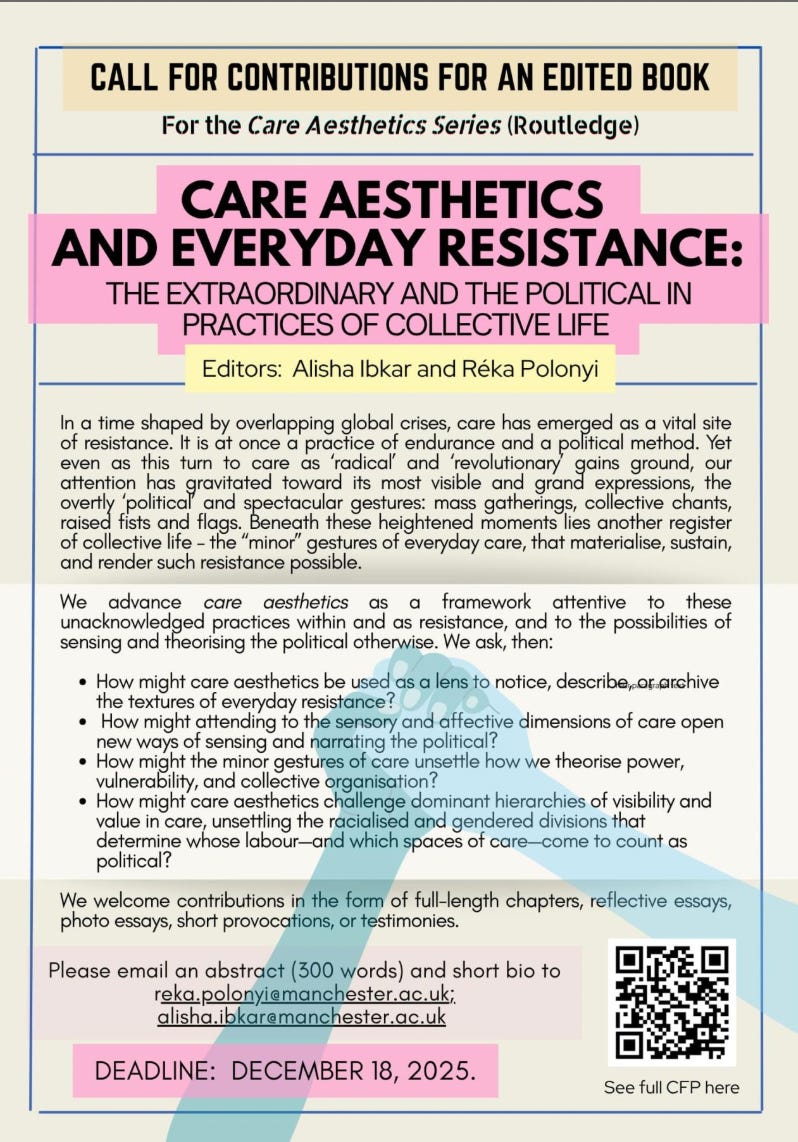
…
The header image for this post is a reproduction of the painting ‘Shaheen Bagh, Delhi’ (2022) by Aban Raza (permission requested).
Extremely well articulated arguments that illustrates the nuances of care work in the South Asian context. There's merits to this kind of public facing work that makes scholarly studies more accessible. Shoutout to Martin for this platform. We need more platforms like this that can draw scholarly voices out of the echo chambers they are otherwise confined within.
This podcast is really interesting! Coming from a STEM background, I’ve never thought so much about how these things get normalised in everyday life, it’s truly eye-opening.