
Disability, dependency, and care - with Eva Feder Kittay
Episode 31 of the Careful Thinking podcast

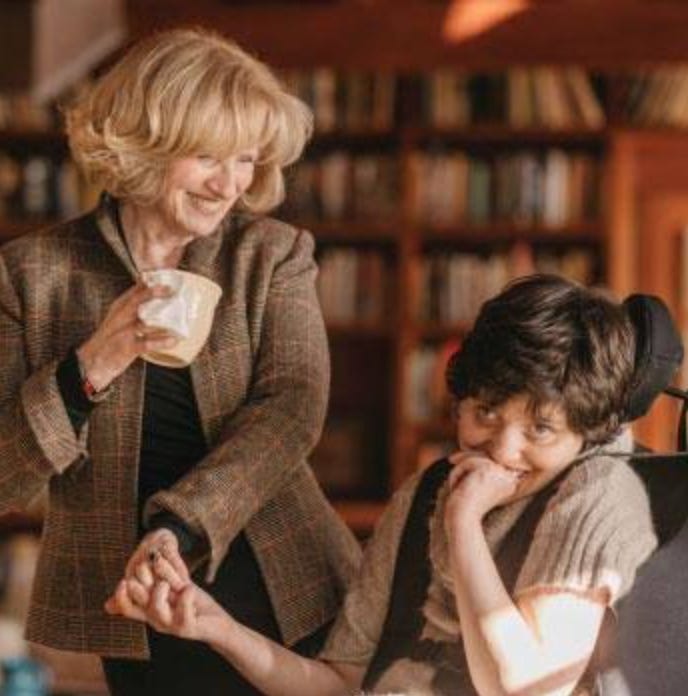
For Episode 31 of the Careful Thinking podcast, I was delighted – and honoured – to welcome as my guest Eva Feder Kittay, one of the key figures in the development of feminist care ethics. Eva, who is Distinguished Professor Emerita of Philosophy at Stony Brook University in New York State, is also a major voice in the emergent field of the philosophy of disability.
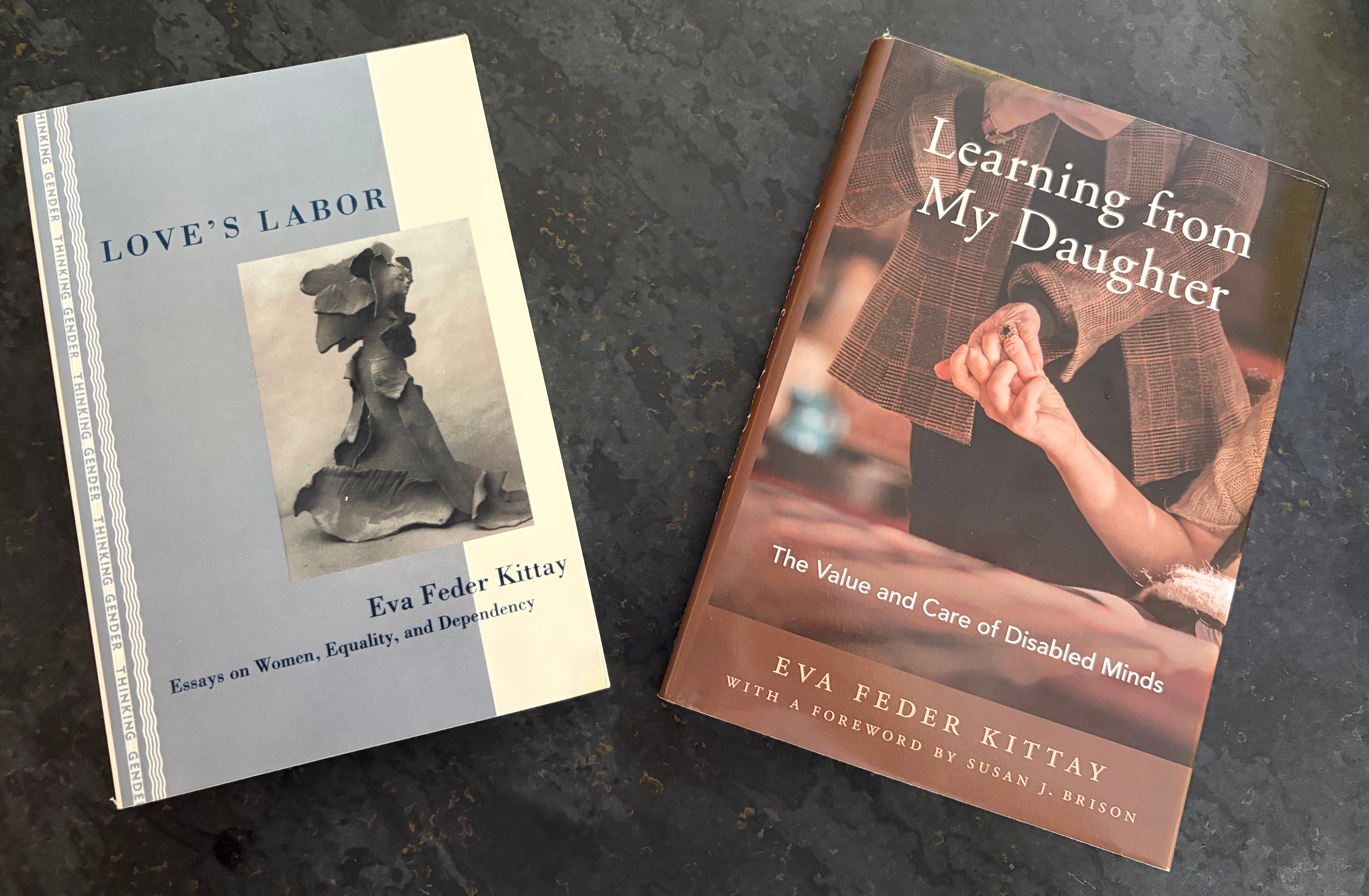
Love’s Labor: Essays on Women and Equality, which Eva published in 1999, was a ground-breaking work in feminist philosophy and remains one of the foundational texts of care ethics. Many of my previous podcast guests have cited the book as a formative influence on their thinking about care.
Eva’s work has been shaped in part by her experience as the mother of Sesha, a woman with significant disabilities, and in 2019 she published Learning from My Daughter: The Value and Care of Disabled Minds. The book was the winner of the 2020 PROSE Award for Excellence in Philosophy and has recently been issued in paperback.
Our conversation on the podcast was wide-ranging, beginning with Eva’s experience of growing up as the daughter of Holocaust survivors in 1950s America, and moving on to her introduction to feminism and political activism in the 1960s and 1970s. Eva explained how her feminist beliefs, combined with her experience as the mother of a disabled child, led to her philosophical interest in issues of dependency and care, and to the writing of Love’s Labor. We discussed some of the main issues covered by the book, including Eva’s insistence that caregivers should be seen as ‘dependency workers’, ‘the de-gendering’ of care, and her introduction of the concept of doulia, as a way of emphasising that caregivers themselves need care, and should be properly supported by society and by public policy.
Moving on to Learning from My Daughter, we talked about its distinctive combination of highly personal and at the same time rigorously philosophical writing. Eva argued that the experience of disabled people like Sesha should prompt us to reconsider what we understand by a ‘normal’ or a ‘good life’. Our conversation circled back to care ethics and to the continuing tension between autonomy and care in the study of disability. Eva insisted that care needs to be ‘completed’ by being received. Our conversation ended, as the book does, with Eva’s beautiful meditation on Sesha’s body as a window on her soul.
There were numerous points of connection between my conversation with Eva and previous episodes of the Careful Thinking podcast. In one of the earliest episodes, Xavier Symons and I discussed the question of personhood in the context of dementia, drawing on Eva’s insistence on relationality rather than rationality as the basis of what constitutes the human person, a subject that I returned to in my conversation with my Open University colleague Vince Mitchell in a later episode. Eva’s suggestion that the future for disabled people might lie in self-organising communities of care, rather than reliance on top-down state support, echoed the work both of Lorraine Krall McCrary, my guest in Episode 23 of the podcast, and my recent Substack interview with Argentinian disability theorist Diego Carmona Gallego, who cited Eva’s work as an important influence on his own research.
I was intrigued by Eva’s admission that her thinking about the role of the state in relation to care had changed over time, and by her claim that she had ‘never really thought that the state would be the only form of doulia’. It was as though she was responding to Catholic legal scholar Erika Bachiochi’s criticism, expressed in her conversation with me in Episode 26 of the podcast, that Kittay ‘wants to right away go to the modern state’ as the default provider of care. And I found Eva’s declaration that we should ‘keep the state pretty far away from the actual dependency relationships themselves’ both surprising and refreshing, echoing as it did some of the arguments I put forward in this post.
It was an enormous privilege - and pleasure - to finally meet Eva, if only online, and to spend time discussing her important work in such detail. I’ve found re-engaging with her writing, and in particular her eloquent reflections on her life with Sesha in Learning from my Daughter, both intellectually challenging and at the same time deeply moving.
I’ve included a few extracts from the episode below, but I’d warmly recommending listening to the whole interview:
I loved doing philosophy of language...But then I went to a conference that had caught my eye and intrigued me, because it was on philosophy and ‘mental retardation’, which was the term of art of the day. And it was quite shocking to me to have all these philosophers there gathered, talking about mental retardation, when they seemed to me not to know a thing about it. It was completely different than my experience of living with my daughter. And I realised then that I had to start writing about Sesha, and I had to start informing these folks of what the phenomenon they had thought they were talking about was really about.
...
One question that occupied me was why most feminist attempts to attack mainstream political and ethical theories...seemed to fall short...And I felt they were not really getting at the heart of the way women were excluded. And that’s when my thinking about Sesha and care came together...And I realised that once you started caring for a dependent person, especially a dependent person who is almost totally dependent, like a young child or my Sesha, you had to become dependent on others for the care of yourself and the person you were caring for. And that meant that the women who cared for dependents couldn’t be the free, equal, independent actors that political philosophy took as a given. So it highlighted the importance of human dependency and its inevitability, and its exclusion in the thinking about political philosophy, about ethics, and the importance of it in the lives of each of us. Since I was living with a dependent...I learned a lot about dependency. And I also needed help from others to care for her. And so I learned a lot about what caregiving is.
...
So this idea of supporting the new mother, that idea I thought would be the idea of doulia as an extension of a public feminist ethic of care. And it’s the extension of the idea that when we care for another who’s unable to care for herself, the carer needs care. But that caring relationship is nested in another relationship of support. But the person who’s supporting them is also in a relationship that requires support. So it’s these nesting relations of dependency that I think are the basis of our society...I mean, if we didn’t need each other in this way, we would all be like the Rousseau natural man, each individual seeking our own sustenance, walking about the forest, not meeting anyone else. But we need each other because we need care.
...
I think the one thing that’s changed in my mind [since writing Love’s Labor] is the recognition of the possibility of caring communities. That is, that people who need care can also sometimes be carers for others who need care. And this is a notion that disability advocates have talked a lot about. And also people of colour who are much more suspicious of the state as a good actor...And so there need to be more ways of thinking of how to organise doulia. And you know, I don’t know what those would be, and caring communities seem to have limitations. Disabled people caring for each other often do need a non-disabled person around who can help in certain ways. So there’s an important struggle to engage in and something to puzzle through that tension, between insisting on support and seeing to it that there is non-domination on the part of those who give support. How to keep power in the right places and out of the wrong places...I never really thought that the state would be the only form of doulia, but I thought it would be the ultimate form of doulia. But that might not be good given the structure of power.
...
Between the time I wrote Love’s Labor and the time I wrote Lessons from My Daughter, I learned a great deal more about disability. So that’s something that informed me not just about Sesha’s particular disability, but living a life of disability. So I think when we look at our children…who don’t exhibit serious impairments and think of perfection or promise or talent, and in our own lives we struggle for meaning, and Sesha strips all of this away. Struggle at times, for sure, but it’s a struggle to keep a bright light shining. We can enjoy talents and intelligence, but the purity of being with her, seeing her take so much joy, particularly in music and really complicated music, to take all that joy, despite all the many limitations, she has many limitations, but it has a profound effect on an understanding of what a good life is. She has a good life, for all her difficulties. She has a good life because she can find joy. And it reveals what is behind the joy we feel in our children, in our work, if we’re lucky. And the reason, as I said, is to take the next breath, despite all the awful things that are happening in the world, where we find ourselves so powerless to affect these things. But that ability to find that spark of joy, it’s just profound when you’re with her.
You can listen to the whole episode here, or wherever you get your podcasts.
You can download a transcript of the episode here:

The header image is a photograph of Eva Kittay with her daughter Sesha (via)
Martin this is fantastic. Dr. Kittay has been foundational, both in my academic curiosities and in my own life as a father to a disabled child. Haven’t listened to the podcast yet but it’s first in the queue for tomorrow!
I’ve just read the Substack and can’t wait to listen to the full episode. So much resonance with how I experienced caring for my husband, who had Parkinson’s. I’m inspired to revisit and explore Kittay’s work more deeply. Thank you!